Wow! So many people entered this contest I’m shocked. 46 threw their hats into the ring and I wish all of you could have won. I was excited since so many people I knew and so many I didn’t showed up. I’m very happy to meet you new folks and grateful for the old friends.
So who won? Number 15 did in my enumeration of comments from the contest post.
I’ve included my scrawled list below:
Yep, Chervatruffle was the winner of the Parker Vacumatic! It’s someone I don’t know which is very cool. Congratulations and I’ll be emailing you for details soon.
The 1920s were the formative period for modern advertising with copy like “somewhere west of Laramie”, slogans like “the pause that refreshes”, and catchy Burma-Shave verse on sequential signs along roads to take advantage of the new mobility. The decade that followed is more exciting to me because it heralded the idea that if products were flashy and futuristic they would be easier to market. Parker didn’t let this slip by them and started a trend in fountain pens where the job done by a few simple parts was replaced by an amalgam of complexity.
Billed as being “like a pen from another world” the Parker Vacumatic was introduced in 1933 sporting a new filling system to replace the old button filler associated with their famous Duofolds. The filling system (usually also called Vacumatic) was a marvel of modern design. Instead of a bladder to hold the ink the barrel itself was a reservoir and even had clear sections to let you keep tabs on your ink supply. Some might complain that it really offered no functional benefit over existing lever and button fillers and they have a point. It actually requires more effort to fill a Vac then the single push or pull of the other systems. Also the pen as mentioned is complex and a lot harder to repair then the old standards. None-the-less this filling system was in use into the late 1940s on the Parker 51.
Let’s take a quick look how the filler works on these pens. The idea is that a rubber diaphragm is flexed up and down by a spring loaded plunger. When released the upward motion of the mechanism creates a vacuum in the barrel which draws ink up through a breather tube attached to the feed of the pen. The downward stroke pushes the air out of the pen hopefully not expelling as much ink as it sucked in. You need to do this 5 to 10 times to fill the pen so it’s a bit like winding a watch. The up side to your work is that the pen can hold quite a bit of ink.
After the Snorkel this is my favorite filling system mainly because I like crazy contraptions. I have a few Vacs and really wanted the Bexley owner’s club pen of a few years back because it actually used recycled filling systems salvaged from broken Vacumatics. However, I really never thought anyone would take the time and effort to design a new pen using this 70 year old filling principle. You probably guessed right away I was wrong.
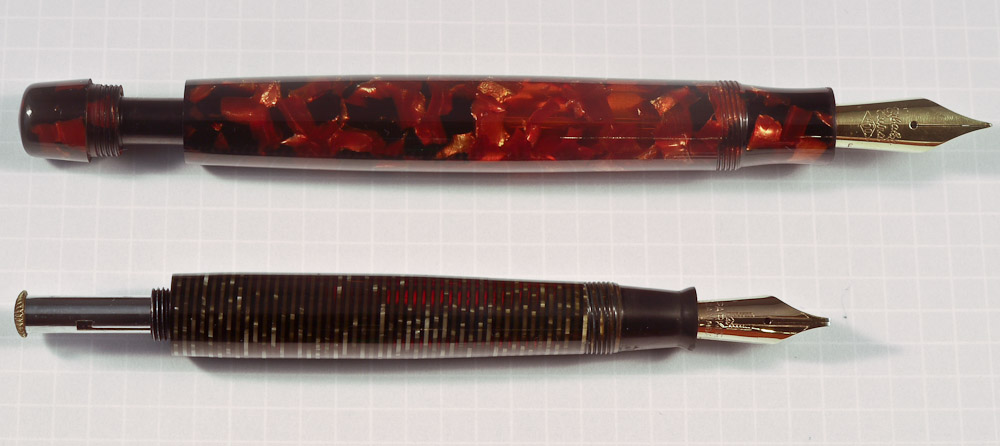
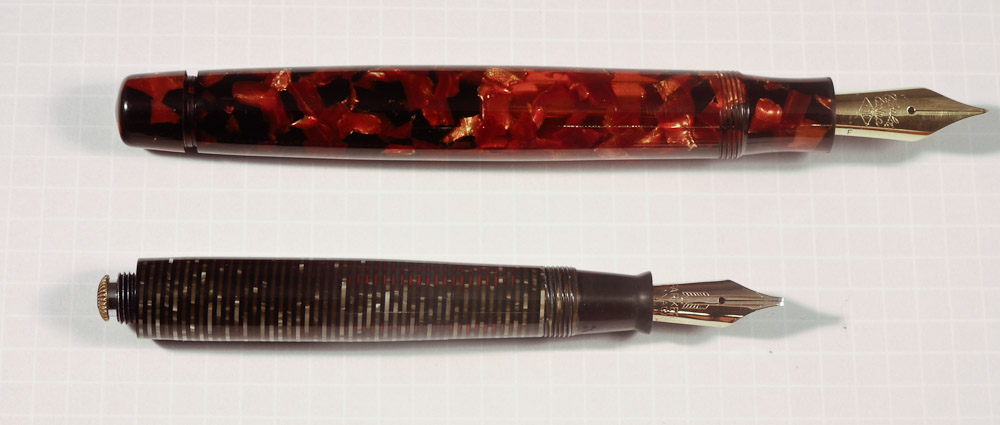
Tibaldi was the name of an old, defunct Italian pen manufacturer. In the go-go premium pen environment near the end of the 20th century a company formed to resuscitate the brand (as was the trend) and designed a new range of writing instruments. Before this version of Tibaldi (the name has been reused yet again) went under they created a number of interesting and sought after pens. One of them is the beautiful Iride pictured here. This pen is made from red marbled celluloid and like pens of yore has transparent areas in the front of the barrel to let you see your ink. It also apes the Vacumatic in the odd decision to use the same filling system. Yes, it’s been redesigned with an integrated blind cap and a plunger larger in girth but it works the very same way and it holds a lot of ink.
Tibaldi Iride. If you click to expand this image and look closely you can see the barrel translucence.
I find it a bit of a mystery why Tibaldi emulated the very first Parker Vacumatic filling unit and not the later ones. Those early “lock-down” units had the pen’s owner retract the plunger into the pen and twist it to lock. The downside is that this last push makes some ink comes out of the pen meaning some lost capacity and that you’d better have it over the ink bottle. Parker introduced the improved “speedline” filler a few years into production, which stayed in the extended position when not being used.
No matter what the Iride is a gorgeous pen with red islands floating in the barrel glinting back at you when the light hits them. I like the simple monochrome nib and the fact the section is of the same material as the barrel. It works and writes well and is really reminiscent of an older pen.
Just to illustrate the similarities between my Iride and an early Vacumatic filler I’ve take some side-by-side images. Both plungers store in the down position via a detent on the Vac and threads on the Tibaldi.
When Tibaldi went out of business a lot of pens were assembled from left over parts and sold. Mine is one of those and I was lucky to find it. The rubber diaphragm in these fillers eventually wears out in time and I hope there’s a lot of life left in my Iride since it’ll be rather hard to find a replacement.
When I was younger a year seemed an eternity. The summer would end and the long winter would creep along as I waited for warmth and fun to return. Now that I’m much older the moments seem to run through my fingers like sand. Yes, an overused metaphor but it’s the first thing I found at the metaphor lending library. Now I’m struck dumb by the fact that I started blogging a year ago today. I’d say, “where did the time go?” but I’m pretty sure there isn’t a temporal reservoir that holds the flow so I’ll forgo doing that.
Looking back and ruminating on the process of writing something and putting it up for people to read I find I’ve only accomplished some of what I wanted to do. Many people share a bit of their souls in blogs giving readers insight into their lives and personality. That’s the one thing I thought I might do but really never did. In the end I did what came naturally to me and wrote about things or events that I thought were interesting.
I feel that a blog is a lot like the old-fashioned vanity press publication in practice and I mean that in a good way. It’s a nice feeling to be able to get ideas out of your head and present them without obstruction. Since I’m not very vain, and when I am it’s in spurts and about silly things, that may explain the lack of more meaningful content over the year.
But there are a lot of good things that came of this endeavor. I managed to keep creating content even if it wasn’t as often as I wanted. Writing is hard for me and I thought doing it more often would make it easier. Well, it didn’t and struggling with that and mostly overcoming it has been a win. Also I think I put out some valuable and semi-interesting information for people who have the same odd interests as I do. Technically it was fun learning how to set up a blog and customize my WordPress theme a bit.
Initially I didn’t tell more than a few people I was blogging and felt odd about promoting my ramblings. I’m mostly over that now and I’m happy to see that both friends and strangers have peeked in and read a bit here. In appreciation I’m giving something away as an anniversary present of sorts: A circa 1941 green Parker Vacumatic. This is a full size double jewel model that was made in Canada. The nib is somewhere between fine and medium with a hint of flex to it and some of the original silver plating still intact. It’s in working order so all you have to do is add ink and go.
Now you are saying “this sounds too good to be true” or at least “what’s the catch?” Well, the pen isn’t perfect. There is a transverse crack in the barrel that doesn’t go all the way through but I’ve stabilized it and it’s not easy to see. The feed is missing a couple of the comb’s teeth and there is a touch of brassing. The filling unit is a plastic one from a later pen and not the aluminum speedline that should be there. Overall this is a user grade pen so don’t expect a museum piece.
Win this pen!
In order to win this pen I’m going to do the usual: count the comments and use a random number generator to choose a winner. However there is one additional requirement: In your comment tell me what the first sentence is you would write with this pen if you win it. That’s all you have to do to be eligible to win! I’ll pay postage anywhere in the world but realize if you are far away from the U.S. it’ll take a while for this to get to you via normal mail. I’ll pick a winner one week from the date of this post. You’ve got 48 hours to respond to the “you won” email or I roll the random number generator again for a new winner.
Thanks very much to all of you for reading my blog over the last year (or just looking at it and grunting). Additionally thanks to all my friends who provided support and so many great comments. Some of them have blogs (better than this one) listed to the right. This here blog certainly has not contained any deep philosophical content or life changing information but maybe I’ll steal some for posts in the second year. A few ideas never were pursued or lived beyond an initial post so perhaps I will revisit them in the upcoming months. Of course any suggestions are always gracefully accepted.
Update:
Here’s a tiny writing sample of the Vacumatic to look at.
I’ve taken up a new hobby in which I can utilize my speck of creativity and natural talent for following instructions. I am such a renaissance man! In honesty I’m more like the guy who got paid a tiny amount to grind the pigment that was mixed with others by a paint maker who the supplied some illustrious Italian master.
The hobby mentioned above is marbling paper. Marbled end-sheets are something I’ve always loved seeing when perusing an old book. The patterns always seemed to be works of ordered randomness with sweep and coloration that are most pleasing. A month or so ago I was at a hotel where an artisan conference had a room where people were selling their wares. One woman marbled not just paper but fabric and leather and I found my love for it hadn’t diminished.
After that I went home and looked up marbling on the web like any good resident of the 21st century would. The process didn’t seem to involve any skills I don’t have like drawing, painting, or imagination. That’s not to say people with those qualifications don’t make excellent marbled papers but just that I could probably put together something that didn’t offend. The next step was to get the supplies and being who I am the research took several hours. I peered at many sites and compared prices and inventory. In the end I got a starter kit from Galen Berry who is a well-known marbler in the United States. I picked out the paint colors I wanted and zipped off an email. Due to the cold weather they didn’t want to ship the stuff until the thermometer took an upward stretch so I had to wait a week or so. Despite the hesitation it arrived the day after a major snow storm which meant that my snow day could be filled with learning how to work this magic.
I’m not going to bore you too much with a history of marbled paper (and other substrates) but I will throw a few facts in here. It began with a process called suminagashi in China over 2,000 years ago but is associated with Japan since it was practiced widely there. The technique traveled the silk trade routes and eventually landed in Turkey. This brought forth the kind of patterns we most often think of when visualizing marbling but the Turkish art of Ebru is far more than that and is worth taking a look at. The video below shows an artist creating some of these works.
httpv://www.youtube.com/watch?v=jgg0GIfbszg
Eventually the technique migrated to Europe in the 17th century when travelers were exposed to both the process and the end result. Artisans guarded their techniques but late in the mid-19th century a book was published laying out the process for all to see.
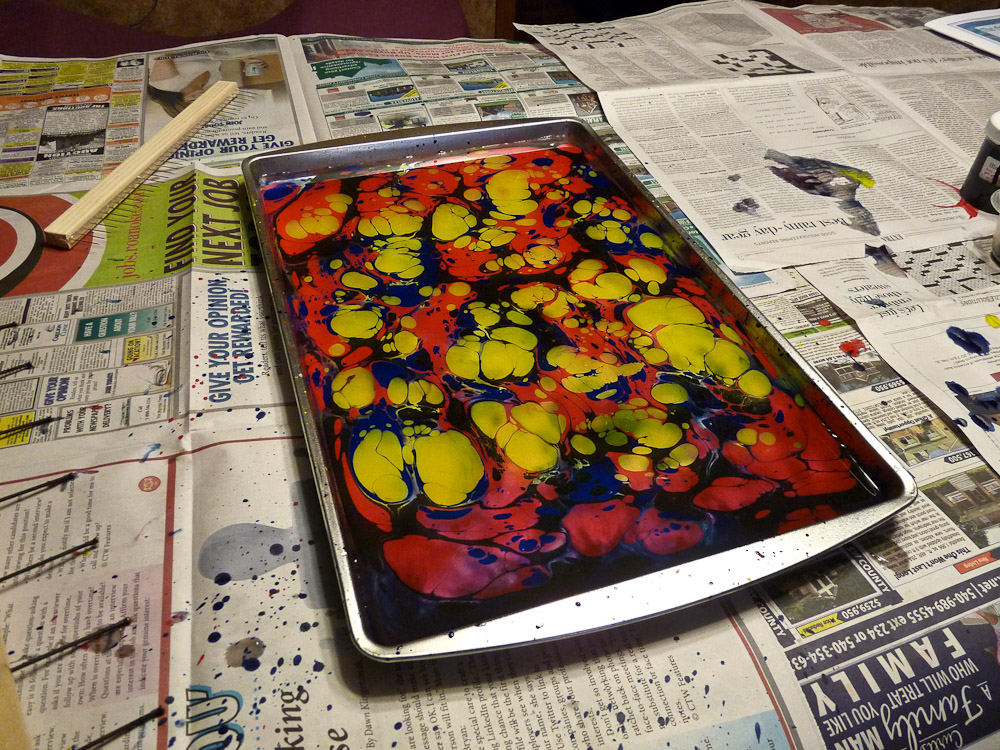
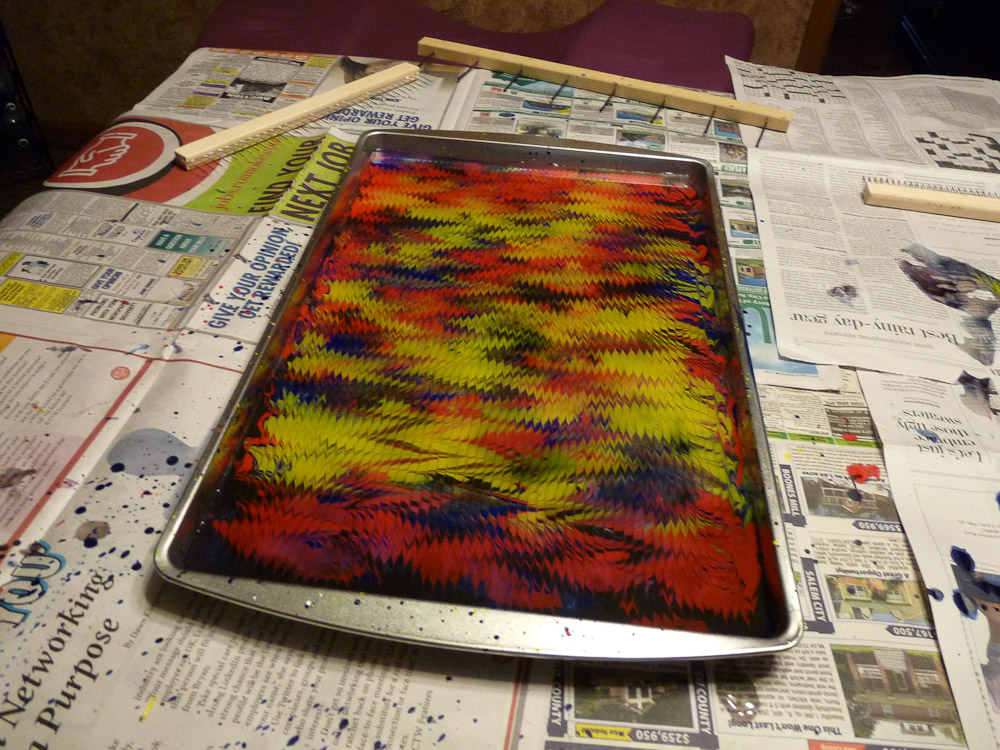
While on the topic of the process it’s really deceptively simple. Paint or ink is floated on top of a liquid and then are manipulated using tools to make the patterns. In my case I use acrylic paints applied to a thickened pool of water. The thickening is accomplished using carrageenan which is the stuff that also is used to make foods goopy. The inks are applied in several ways with brushes made out of broom straw (actually, they are shaken and don’t touch the liquid) or eye droppers. After that there is a bevy of tools to rake, comb, curl, and speckle until you get a design you love.
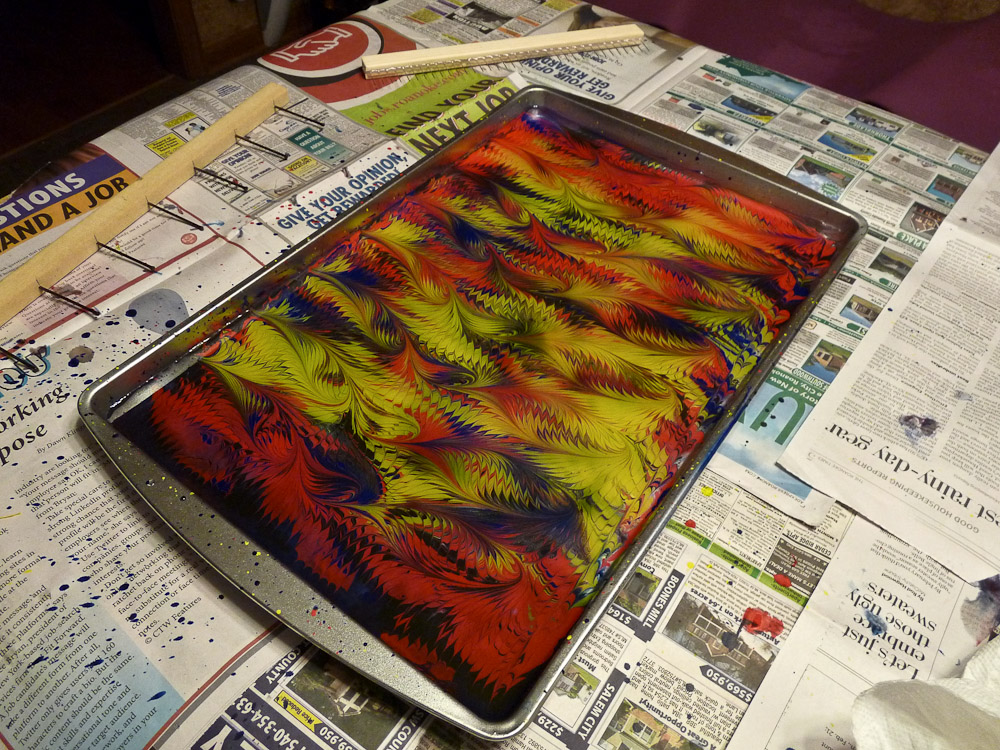
Below are a few pictures from one of my sessions just to give you a rough idea of a few steps in the process. I’ve been having fun and hope to improve my skills with time.
It is good that Sheaffer Snorkels came in colors. I find just having the choice of a pen in one hue to be rather boringly monochromatic. In the wacky world of collecting there are always some items that stand out in rarity due to such things as size, material, pattern and other differentiating characteristics. With Snorkels color is an important variable (along with nib type and build material) in determining value.
There are two separate periods when Sheaffer messed with color choices for these pens. The early pocket pens were made in what I’ll call (not that it’s unique to me) the “pastel” colors. These were Black, Pastel Blue, Pastel Green, Burgundy, and Pastel Grey. All pleasant colors but as 1956 dawned the U.S. was awash with fancy named choices for the finishes on the cars, appliances, and furniture people wanted. When a Cadillac could be had in bahama blue why not your pen? It was with thinking like that a new range of crazy colors was added to the Snorkel lineup: Fiesta Red, Vermilion, Mandarin Orange, Sage Green, Fern Green, Peacock Blue, Periwinkle Blue, and Buckskin Tan.
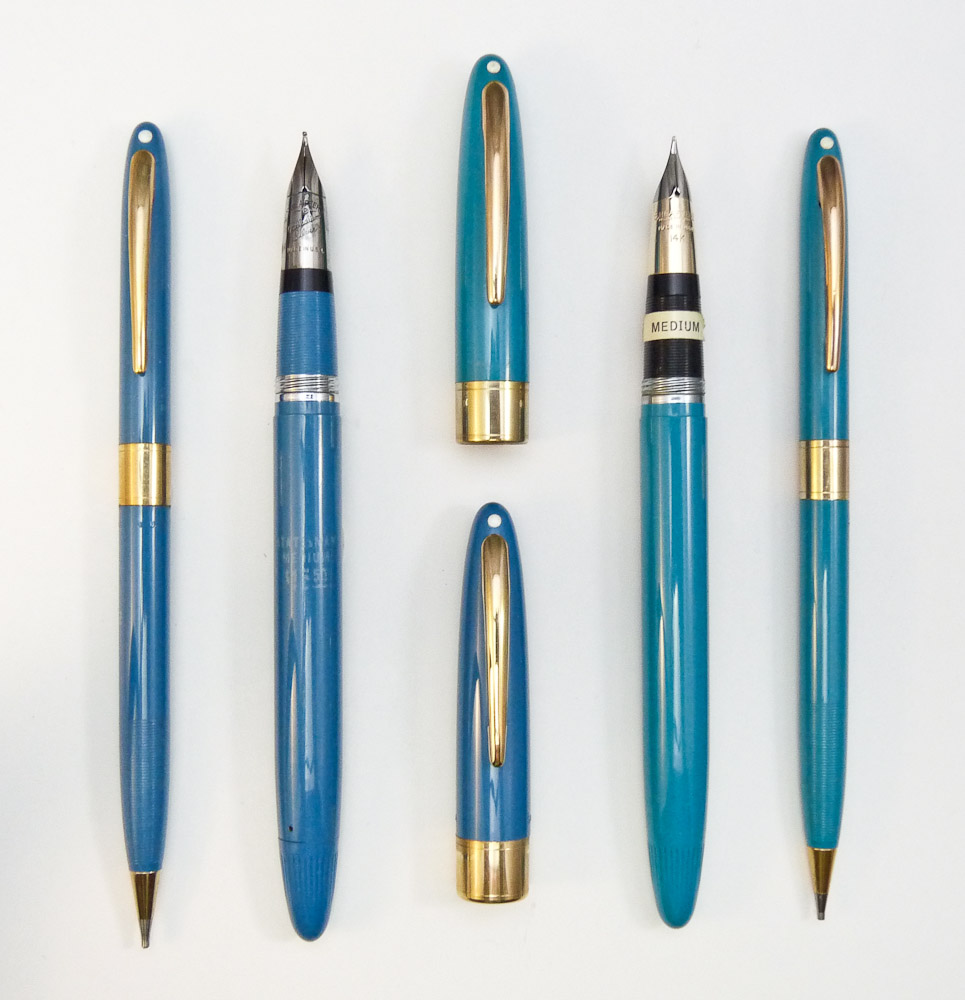
I’ve got most of the colors above and keep my eyes peeled for when rarer examples like Mandarin Orange appear. Another one that’s hard to get one’s hands on is Peacock Blue. The problem is that pictures of blue Snorkels tend be hard to interpret as pastel blue and peacock blue could look alike depending on exposure, lighting, camera quality, etc. I’ve seen many a pen for sale that looked “Peacocky” and just turned out to be over exposed. In order to help the two or maybe even three people who care about this I will provide the number of a good therapist. Actually, I’ll just show a photo I took of two side by side so you can see the difference. It probably won’t help too much but you never know.
Paste Blue set on the left and to the right is a Peacock Blue set.